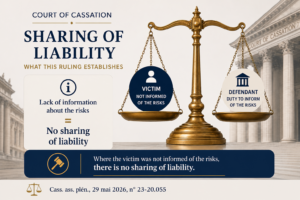
Note on Cass., ass. plén., 29 May 2026, no. 23-20.005, B+R
On 29 May 2026, the Plenary Assembly (assemblée plénière) of the Cour de cassation handed down an eagerly awaited decision on personal injury.
The facts were of a sad banality: during a summer camp, a fifteen-year-old adolescent suddenly dived into shallow water and was injured. He would be left with severe after-effects — tetraplegia. One notes the considerable length of the proceedings, the accident dating back to 2006.
The victim and his parents sued the organising association and its insurer for compensation.
The Court of Appeal (Douai, 11 May 2023) held the association liable, but apportioned liability. It attributed a 60% share to the victim, for having dived « suddenly and without any precaution ».
Compensation was therefore limited to 40% of the loss sustained.
A simple but crucial question was put to the Cour de cassation: can the mere imprudence of the victim of a personal injury reduce her right to compensation?
Under the general law of liability, the answer admits of little doubt. The victim’s fault reduces her right to compensation in proportion to its causal role. It may even wholly exonerate the defendant where it displays the characteristics of force majeure.
This the Cour de cassation takes care to recall at the outset: « according to settled case law, unless it displays the characteristics of force majeure, the victim’s fault which has contributed to the occurrence of her loss constitutes a ground for partial exoneration of liability, whatever the nature of the liability incurred and of the loss sustained ».
Note the generality of the statement: the rule applies whatever the nature of the liability and of the loss sustained. This holds broadly true, setting aside certain special regimes such as the loi Badinter (the Act of 5 July 1985 on road-traffic accidents), which affords the non-driver victim a protection exceeding the ordinary law.
Having laid down this general reminder, the Cour de cassation initiates a significant shift.
It stresses the specificity of personal injury, « characterised by an impairment of the physical or psychological integrity of the person ». For now, that specificity remains modest, being embodied, in the general law, in Article 2226 of the French Civil Code — which removes the action arising from personal injury from the ordinary five-year limitation period and from the long-stop period of Article 2232 — and, in special law, in Article 3 of the loi Badinter referred to above.
De lege ferenda, one could go further in addressing this specificity of personal injury. One bears in mind the exception to the principle of non-option (the ill-named rule of « non-cumul »): Article 1233-1 of the draft reform of civil liability anchors personal injury in the law of extra-contractual liability while allowing the victim to prefer contractual liability — retaining the benefit of the contract (a strict, result-based safety obligation) without bearing its limits (limitation-of-liability clause, clause shortening the limitation period, and so forth).
The text provides: « Loss resulting from personal injury is compensated on the basis of the rules of extra-contractual liability, even where it is caused in the course of performance of the contract. However, the victim may rely on the express stipulations of the contract that are more favourable to her than the application of the rules of extra-contractual liability».
One also thinks of Article 1254 of the same draft, which provides that « the victim’s breach of her contractual obligations, her fault, or that of a person for whom she is responsible, are partially exonerating where they have contributed to the occurrence of the loss. In the case of personal injury, only a gross fault can give rise to partial exoneration ».
In other words, only the victim’s gross fault could give rise to an apportionment of liability.
This shows how tempting the opportunity was for the Cour de cassation to take the step and to enshrine what the legislature has for years struggled to achieve: a change to the rules governing compensation for personal injury where the victim is at fault.
On this point, the decision will disappoint those who expected the Plenary Assembly to « anticipate » the reform of civil liability by confining apportionment of liability to situations in which the victim’s fault is « gross » or of particular gravity.
One notes here that the Douai Court of Appeal had taken care to characterise the young diver’s imprudence as « grave ». The Cour de cassation could have seized upon this.
It does not.
Yet the decision opens a new front.
To that end, the Plenary Assembly first takes up the concept of the duty to inform. At paragraph 7, the decision recalls that « in order to prevent the occurrence of such harm, duties to inform and to warn rest on the professional as regards the safety risks associated with the performance of its service, in particular in respect of sporting or leisure activities ».
The reasoning begins to show: had the professional informed the victim, she would (no doubt) not have exposed herself to the risk. Applied to the case, the reasoning means that, had the camp supervisors warned the youngsters that the water was too shallow to dive into, the victim would not have dived.
It is indeed this reasoning that the Court sketches at paragraph 8: « in the case of an imprudent fault of the victim, the professional’s breach of the aforementioned duties — compliance with which would have been such as to prevent the accident — does not permit a causal link to be found between that fault of the victim, who was not informed of the risks, and her personal injury ».
The reasoning, causal in nature, allows the judges to avoid opening a debate on the gravity of the fault, and to avoid setting a threshold below which the victim’s fault cannot be raised against her — much as the law provides in respect of road-traffic accidents.
It is thus causation, a flexible concept, that underpins the solution.
This causal reasoning is open to discussion. It seems to us that it does not escape a degree of artifice. Stricto sensu, the victim’s fault did contribute to her loss. Had she not dived, she would not have been injured.
This absorption of the victim’s fault (the victim being a minor, which the Court does not mention) by the organiser’s fault may be understood in light of the policy aims driving it. But on strictly causal ground, it does not wholly carry conviction.
Were one to reason, as under the general law, in terms of a (negative) loss of chance, one would reach a different solution — namely, assessing the chances that the victim, better informed, would have avoided the harm (by not diving). Here, the Cour de cassation short-circuits the loss-of-chance analysis, seemingly treating the victim’s active role as immaterial.
At paragraph 9, the Court states that there is « accordingly ground to rule henceforth that, since the professional organiser of a sporting or leisure activity is bound to give the safety instructions necessary for the practice of the activity and adapted to the public concerned, in the absence of such instructions it cannot, in the event of personal injury suffered by one of the participants, obtain an apportionment of liability by invoking imprudence on the part of the victim ».
The principle set out supra is here refined, hedged about with a number of conditions.
For apportionment of liability to be refused, the following are required:
- that the organiser of the sporting or leisure activity be a professional — which will no doubt exclude a number of cases of family or voluntary supervision;
- that the organiser have given no safety instruction whatsoever, since the decision refers to « the absence of such instructions ». This augurs interesting debates where the information was insufficient or piecemeal. What if the supervisors had said « be careful when diving! »? It should be noted that, in this case, the supervisors had allowed the children to bathe, but the question of diving had, it seems, not been addressed.
In short, the Plenary Assembly strengthens the rights of the personal-injury victim; but the road still appears long, and the need for a thorough reform of the law of civil liability is felt all the more keenly.
Takeaways
- The decision of 29 May 2026 is not a new Desmares — that 1982 provocation by the Court designed to prompt the legislature to react.
- Rather than seizing on the gravity of the fault to confine apportionment of liability, the Cour de cassation adopts a different technique: causation.
- Where the professional organiser of a sporting or leisure activity, bound by a duty to inform, gives no safety instruction, the victim’s imprudent fault cannot be raised against her, whatever its gravity.