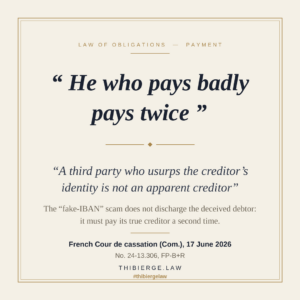
Note on Cass. com., 17 June 2026, no. 24-13.306, FP-B+R
In a decision delivered by the full bench of the Chamber and destined for the honours of both the Bulletin and the Annual Report, the Commercial Chamber of the Cour de cassation, presided over by Vincent Vigneau, last Wednesday answered a question of considerable practical importance.
Where a fake-IBAN scam has occurred, whom should the law favour — the debtor who has paid the fraudster, or the creditor who has received nothing?
Faced with this question, some thought to invoke the doctrine of the apparent creditor under Article 1342-3 of the French Civil Code, which provides that « payment made in good faith to an apparent creditor is valid ».
Applied to the letter, the rule would make payment to the fraudster a discharging payment. The debtor could not be compelled to pay a second time. The creditor, however, would be sorely aggrieved, having delivered goods or rendered services without receiving any payment.
This dilemma called for a clear answer from the Cour de cassation, so divided was the case law of the lower courts.
On 17 June 2026, the Commercial Chamber of the supreme court held that « a third party who usurps the creditor’s identity is not an apparent creditor, within the meaning [of Article 1342-3 of the Civil Code] ».
It follows that the victim of the « fake-IBAN scam » is not discharged. Our deceived debtor will have to pay its true creditor a second time.
On the facts, the case was of a regrettable banality — and will no doubt stir a few memories among the participants in the 2025 Willem C. Vis Moot.
In May 2018, Petrogarde, a company specialising in the supply of combustible products, was approached by Eazybunker, a commercial intermediary, to supply gas oil to the vessel Afthonia, on behalf of a third company, Sea Fleurs, during a port call at Marseille. Delivery took place on 19 May 2018; an invoice for EUR 103,375.64 was issued.
On 22 May 2018, Eazybunker, the intermediary, received an email from an address « differing by only a single letter » from Petrogarde’s genuine address, together with an invoice and bank account details (a RIB).
The intermediary forwarded these documents to Sea Fleurs on 23 May and 4 June.
On 8 June 2018, Sea Fleurs complied and transferred the funds to a fraudster’s account.
The funds could never be recovered.
Petrogarde, the unpaid creditor, then sued Sea Fleurs for payment of the price and, in the alternative, Eazybunker for damages.
At first instance, the Marseille Commercial Court ordered Sea Fleurs to pay.
That decision was reversed on appeal, the Aix-en-Provence Court of Appeal preferring to discharge the debtor. On the basis of Articles 1342-2 and 1342-3 of the Civil Code, the Aix court held that Sea Fleurs « could legitimately believe, when making payment on 8 June 2018 […], that it was dealing with its creditor Petrogarde, having regard to the circumstances of the transaction ».
This is the focal point of the appellate decision: the immaculate innocence of the solvens.
Since Sea Fleurs had never been in direct contact with Petrogarde, everything passing through Eazybunker, « it was not for it to verify the validity of the email address ». Moreover, examining the bank details alone, associated with the account holder (« SAS Petrogarde »), could not have enabled our victim to « detect a fraud ».
Hence the Court of Appeal’s conclusion: since the debtor could be charged with neither negligence nor disloyalty, its payment was discharging.
On its face, the lower courts’ reasoning rested on Article 1342-3 of the Civil Code, which stems from the Ordinance of 10 February 2016. That provision, which carries forward the former Article 1240 (which already validated payment made in good faith « to the person in possession of the claim […], even though that possessor is subsequently evicted »), is one embodiment of the doctrine of appearance — a doctrine that gives effect to certain irregular acts because the counterparty could not legitimately know that it was dealing with an unauthorised person, whether the apparent agent (Article 1156 of the Civil Code: « An act performed by a representative without authority or beyond his authority is unenforceable against the represented person, unless the third party contracting with him legitimately believed in the reality of the representative’s powers, in particular by reason of the conduct or statements of the represented person ») or the apparent creditor.
It remains to be agreed what an « apparent creditor » is.
The Court of Appeal had adopted a broad understanding of it. In its eyes, the apparent creditor was the fraudster. Why? Because, apparently, he was the creditor. His email address was, give or take a single letter, that of the true creditor. His bank details read « SAS Petrogarde ». To all appearances, he was the creditor.
This is not inaccurate. The appearances were plainly deceptive for the debtor.
Indeed, some lower courts have already invoked this doctrine of the apparent creditor to discharge the deceived solvens(see in particular Créteil Commercial Court, 22 July 2025, no. 2024F00526; Montauban Commercial Court, 28 May 2025, no. 2024005963). Conversely, other lower courts have refused to recognise the fraudster as an apparent creditor (Strasbourg Judicial Court, summary proceedings, 27 Nov. 2024, no. 24/00409), so that the question called for an answer from the Cour de cassation.
In equity, the solution adopted by the Aix-en-Provence judges is understandable. Since one must choose between two evils, some may be tempted to prefer the solvens to the unpaid creditor. It is true that condemning the solvens to pay a second time, with no real prospect of ever recovering from the fraudster, may seem harsh.
Conversely, it is just as iniquitous to deprive the creditor of any recourse against the debtor. A business that performs without receiving payment may suffer drastic consequences.
Beyond these ethical considerations, it is the rule of law itself that appears to condemn the Court of Appeal’s position of discharging the solvens deceived by appearances.
Now, Article 1342-3 of the Civil Code, a provision concerning payment, succeeds the former Article 1240 of the Civil Code, which provided: « payment made in good faith to the person in possession of the claim is valid, even though that possessor is subsequently evicted ».
One then understands that the apparent creditor is the person who is « in possession of the claim ». The formula is perhaps not entirely limpid, but the idea underlying it is clear. The apparent creditor exists only by comparison with the true creditor. The notion of apparent creditor is meaningful only where two persons could lay claim to the status of creditor. Such is the case, in particular, with the assignment of a claim. If the debtor has not been notified of the assignment, it may validly discharge its debt into the hands of the assignor, even though the latter is no longer the creditor (Article 1324 of the Civil Code).
In short, the notion of apparent creditor is intended to operate only where several persons could claim the status of creditor and the debtor, in good faith, mistakes one for another.
It is not intended, a contrario, to produce its effects where a person having no right to the claim, never having been in possession of it, succeeds by unlawful means in passing himself off as the creditor.
This is the meaning of the Cour de cassation‘s holding: « a third party who usurps the creditor’s identity is not an apparent creditor within the meaning of this provision ».
The Court went on to make clear that Sea Fleurs, « which knew that its creditor was Petrogarde, had not paid the sum due to an apparent creditor, but to a person fraudulently passing himself off as Petrogarde ».
In holding otherwise, the Court of Appeal misapplied the provision, hence the quashing on the basis of Article 1342-3 of the Civil Code.
Two situations must therefore be distinguished: error as to the person of the creditor; and error as to the creditor’s bank details.
In the first case — the only one covered by Article 1342-3 of the Civil Code — the debtor faces several putative creditors and discharges into the hands of the wrong one.
In the second, the debtor has only one creditor, is not mistaken as to the person of that creditor, but is deceived by someone passing himself off as the creditor.
Our cheated debtor was not mistaken as to its creditor.
The Court of Appeal’s error was to focus on a single criterion: the debtor’s good faith. Plainly, Sea Fleurs had committed no fault. It was never mistaken as to the identity of its creditor. It knew full well that it owed the price to Petrogarde. It was mistaken, following a fraudulent scheme, as to the payment details — which led it to transfer the funds to a third party.
Article 1342-3 governs error as to the person of the creditor, not error as to the payment details. The fraudster who usurps the creditor’s identity gives rise to no distinct apparent creditor: he merges into the true creditor. There are not, here, two creditors — one real, the other apparent — between whom the debtor might be mistaken; there is only a single, perfectly known creditor, and a fraudster who diverts payment away from him.
The solution thus appears technically sound.
It also aligns with the case law of the Conseil d’État which, faced with the same fraud committed to the detriment of a public purchaser, had refused the public entity the benefit of the apparent creditor (CE, 21 Oct. 2024, no. 487929).
Finally, if the solution may seem harsh on the debtor who committed no fault, it must be stressed that the creditor committed none either. It would be no fairer to deprive the innocent creditor of its right to payment.
The debtor so ordered is not, however, without recourse: beyond the (often illusory) action against the fraudster, it may seek to hold the negligent intermediary liable, just as the Conseil d’État allows against a contracting party that contributed to the fraud.
Takeaways
- A debtor who falls victim to a fake-IBAN scam cannot rely on the doctrine of the apparent creditor.
- He who pays badly — even under a fraudster’s influence — pays twice.